White Tea Assessment: Professional Guide to Tasting
1. Forward
This is the fourth entry in our series on Chinese Tea Assessment, but it is the first to have been directly guided and informed by leading experts. July 21st to 24th, the Fujian Tea Research Association, in collaboration with the World Tea Union, hosted the first-ever tea assessment certification course designed for foreigners. We took part in this and left with a trove of information about all things white tea. Guo Yaling, the main instructor, is a co-editor of the national textbook we used for the past three entries on general principles, green tea, and dark tea. It was her professor, Chen Chuan, who first codified the contemporary “six categories of tea” schema (white-green-yellow-Oolong-red-dark) we all know today. It was Guo and her peers who set up the common framework for white tea assessment that is still used today.
We have done our best here to summarize the theoretical and practical information on white tea assessment as they taught it. Their word is by now means law, nor is their assessment framework perfect, but it is the one that informs local competitions, market regulatory bodies, and all the young technical talent that now seek employment in the Chinese tea industry.


(Professor Guo’s Theoretical Class; Teacher Lai’s Practicum)
2. Theory - What is White Tea
2.1 Traditional White Tea Characteristics
A lot of tea assessment is trying to identify where a given tea fails to meet the norms of the intended style or category. When it comes to white tea, tea assessors would expect a white tea to possess all the following characteristics:
1. A tea that has not undergone high temperature de-enzymization like wok-frying.
2. A tea that has not undergone kneading (aka laceration) of any kind.
3. Has silvery green leaf color as a finished tea.
4. Has ample visible white trichomes (aka down/fuzz/hair).
5. Clear light liquor color.
Traditionally, it was white tea from Fuding and Zhenghe that experts had in mind when they building their assessment framework. These two places were the sources of white tea that were exported to Hong Kong or Europe to be used by tea blenders circa 1980. They wanted to make sure that the state-run factories of the day in northern Fujian were producing tea that consistently looked and tasted what importers were accustomed to receiving. The most critical element that these teas needed to deliver was being “tippy.” That means that there are ample white trichomes present on the leaf, providing a distinct (haoxiang) aroma, which can be experienced as a creamy, peanuty, or a grain-like scent/flavor. With that in mind, we will elaborate more how white tea from this area has been further subdivided and defined, before discussing more unorthodox, “new style” white tea.
2.1a Pick Shape. This is the first, most important way to categorize white tea, and all four basic shapes are well-known to white tea drinkers: Baihao Yinzhen(Silver Needle), Baimudan(White Peony), Shoumei, and Gongmei.
Silver Needle. Most basically, this means a single plump, silvery white bud. This bud should not be thin, partially opened, reddish, bug-bitten, or blackened from frostbite or rain. In aroma, you are generally looking for a clean crisp flavor, provided by the tea amino acid content of the immature buds. In aroma, you want that pure tippy taste.
Baimudan. Two leaves, partially opened around an immature core bud. Assessors associate this pick shape with a greyish green leaf color, slightly less visible trichomes, an “apricot yellow” tea soup, and a flavor that is fresh and mellow.
Shoumei. One bud and up four leaves, with an elongated stem connecting the leaves. As the material is older, it does not need to have a fresh or tippy profile, but be sweet and thick in absence of harshly sour or bitter notes.
Gongmei. This is a white tea made from heirloom cultivars rather than the more mainstream Dabai or Shuixan cultivars used more commonly today. They may have one bud and no more than three leaves. Assessors would expect not a tippy aroma, but a freshly vegetal and sweet (qingtian) profile.
2.1b Cultivar Material
Table 1: Fujian White Tea Cultivar Materials
|
Cultivar |
Origin |
Growing Characteristics |
Taste Profile |
|
Fuding Dabai GS13001-1985 |
Fuding, Taimushan |
Clone, medium-sized leaves, early season pick. |
Thick plump buds, fully covered in white trichomes, somewhat floral in aroma, fresh and mellow in taste.
|
|
Fuding Dahao GS13002-1985 |
Fuding, Wangjiayang Village |
Clone, large leaves, early season pick. |
Large tippy buds, fully covered in white trichomes, aroma somewhat tippy, fresh and mellow in taste.
|
|
Zhenghe Dabai GS13005-1985 |
Zhenghe, Tieshan Town |
Clone, large leaves, late season pick. |
Tippy pump buds, dark green in color with some white trichomes, aroma is akin to rose, with a strongly thick, but fine flavor. |
|
Fu’an Dabai GS13003-1985 |
Fu’an, Tangcuo Village |
Clone, large leaves, early season pick. |
Tippy pump buds, aroma is clear and floral, flavor is strong and mellow.
|
|
Fujian Shuixian GS13009-1985 |
Jianyang, Xiaohu Town |
Clone, large leaves, late season pick. |
Large tippy buds, color is green with some white trichomes, aroma is akin to orchid or rose, flavor is strong and mellow. |
|
Jiulong Dabai MSC-199801 |
Songxi, Shuangyuan Village |
Clone, large leaves, early season pick. |
Buds are thick and some what “tippy, ” with a rose or woody aroma and a strong and mellow flavor. |
|
Caicha / Xiaobai |
Miscellaneous |
Seed-grown, varied shape and pick time.
|
Buds are tiny and delicate, green in color and slightly tippy. |
Familiarity with these different cultivar materials is now essential in white tea assessment. Even in the 1980s, one needed to know that darker, longer leaves from Zhenghe were a natural characteristic of the local material, and not evidence of a later (cheaper) pick. There was once a basic division of “west-road” silver needle and “north-road” silver needle, with the former meaning Zhenghe material and the latter meaning Fuding material. In those days, these terms also implied a slightly different drying process, helping Zhenghe whites to be more floral, and Fuding teas to be more tippy and mellow. Now, Shuixian and the five other recognized Dabai/Dahao cultivars listed above are what are usually utilized in commercial white tea production. These materials can consistently deliver the tippy or floral white tea flavor profile that buyers expect, and are usually subdivided into the pick shapes listed above. They all come with a special serial number and document that carefully defines how these tea cultivars should grow, look, and taste. One can find these teas planted well beyond their geographic place of origin. Meanwhile, Caicha, AKA Xiaobai, is really a catch-all term for tea made from any other seed-grown heirloom cultivar, and is thus not expected to have the classic white tea shape or flavor. For simplicity’s sake, teas made from Caicha are all usually grouped as “gongmei,” but there is no shortage of producers who still label such tea as silver needle, white peony, or shoumei.
2.2 New Style White Tea Characteristics
White tea is no longer a marginal export product, but something being made nationwide, mostly aimed at the domestic market. Massive quantities of white tea are now produced in Yunnan Province, and once experimental white tea projects in Gansu, Guangxi, Jiangxi, Hubei, Zhejiang, Sichuan, Taiwan, and Hunan are now all maturing. While all of these teas may be called “caicha” by Fujian market actors, assessors instead have to think of them as a whole new category of production: “new processing style white tea(新工艺白茶).” Some of them break the most basic rules of white tea: Sangzhi White Tea in Hunan can undergo Oolong-style “Yaoqing,” while Longnan white tea in Gansu can undergo red tea-style kneading. Many of them, like Moonlight White in Yunnan or white tea made from Huangjinya in Zhejiang, have a totally different flavor profile than traditional white teas in Fujian. Assessors expect these teas to broadly be redder or darker in color, be less tippy, but hopefully still sweet despite some extra bitterness. These differences cannot be understood as flaws, but are problematic to score, as you will see below.
Original production areas have elaborated their processing to keep up with the new competition. If you drink white tea, you have probably experienced one consequence of that, which is pressing. Pressed white tea is almost always aged, which means that it may be darker, sometimes even pinkish in liquor color, less fresh in aroma, and sweeter in flavor. Pressed teas also have to be assessed somewhat differently, including comments on the tightness of the pressing, and completeness of the shape. Some of these pressed white teas now also include the same yellow Eurotium cristatum fungus utilized in Hunan to help age tea bricks, which can add a stimulating fungal aroma that has never been associated with white tea. White tea was once intended to be sold exclusively fresh and new, but that is no longer the case. Professional tea assessment is still adapting to this new situation.
3. Theory - Tasting & Scoring White Tea


(Waiting to pour out nine mugs' worth of tea; weighing white tea on special analog scale)
3.1 Assessment Process
As seen with assessment in other categories of tea production, white tea demands a scored appraisal on the dry tea leaves, liquor, aroma, flavor and dregs, which our teachers prefer to translate as “infused leaves.”
The dry leaves are first appraised in a square white container, where assessors look at and prod the leaves to understand the shape, color, purity, and integrity of the leaves. A broken leaf is a sign of poor integrity, a thin bud a mark of poor shape, the presence of a tea flower a problem of purity, and a lack of those essential white fuzzy trichomes a fatal issue of color. After the dry leaf assessment is done, 3 grams are carefully weighed out for the four subsequent appraisals.
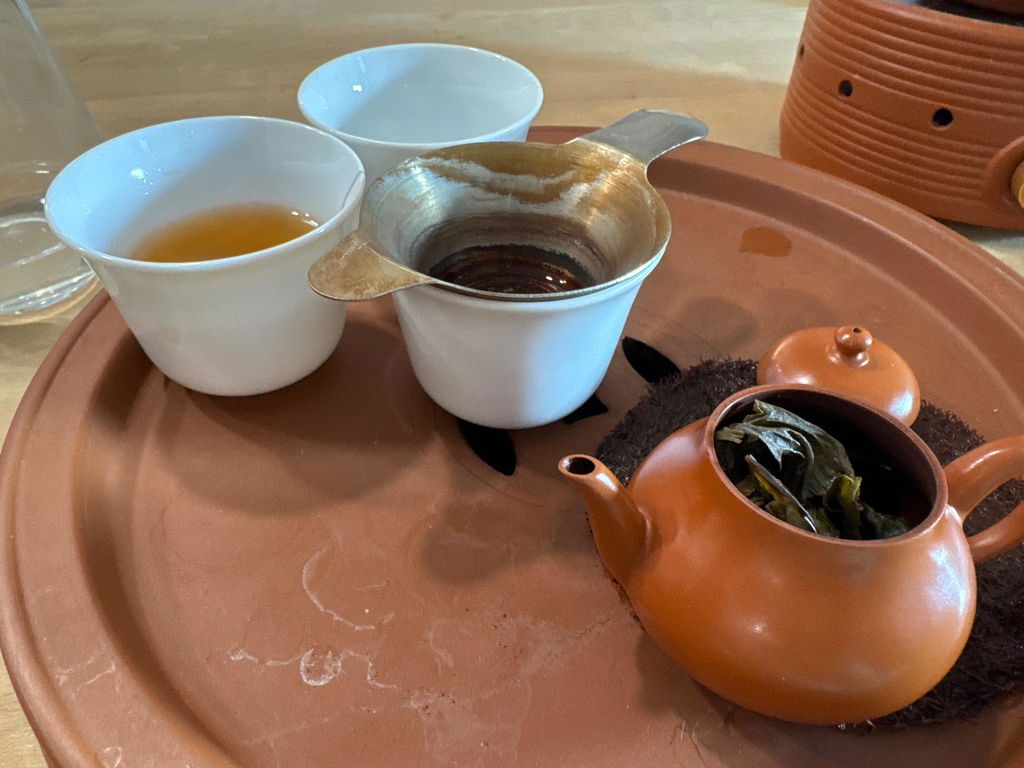
After infusing for 5 minutes at 100°C in a white ceramic lidded mug, the tea liquor is poured out into a special tea bowl. In this bowl, the liquid is stirred once so any particulate matter can concentrate in the center of the bowl. Assessors ideally want to see a light, clear apricot yellow color. They would be concerned to instead find a dark reddish or brown broth with a lot of visible matter, other than trichomes, on the surface or bottom of the liquor.
While one is appraising the liquor, the aromatic compounds suspended in the lidded mug will cool down to temperatures where the aroma can be safely smelled by a human nose. As it cools down, three “whiffs” will be made by the assessor. The first “hot whiff” will be looking for any sharply astringent, sour, or impure smells that jump out at higher temperatures. The second, “warm whiff,” tries to understand the relative profile of the tea. It is with the second whiff you’ll want to say whether or not it is tippy, sweet, fresh, grassy, etc. On the final “ cold whiff,” you want to get a sense of whether or not the aroma is long-lasting. If you cannot smell anything, either you left the lid off for too long or the tea in question has a genuinely weak aroma.
Flavor is assessed using a smaller tasting cup. Tea is spooned out from the tea bowl while still warm, and sipped thoroughly. The goal is to feel what the tea does from the first moment it crosses onto your tongue. Do you experience bitterness on the base of your tongue? Sweetness towards the front? Is the tea thickly viscous as it rests between your tongue and the roof of your mouth? What flavor lingers in the mouth, throat, and nasal cavity? Hopefully, that creamy, sweet, and savory “tippy” flavor should be obvious, with as little astringency or grassiness as possible.
The infused leaves are scraped out from the mug and are assessed either in a white enamel basin or smaller black vessel. For the highest score, assessors want to see tender buds attached to no more than 1-2 leaves, no red leaves, dark spots, or evidence of damage.
3.2 Scoring White Tea
Table 2 Basic Scoring Rubric
|
外形 Dry Leaf (25%) |
A (90%) |
Single buds, one leaf + one bud material; plump and tippy buds; beautiful shape; unique; white with some green in color; pure and complete leaves. |
|
B (80%) |
Single buds, one leaf + one bud material; small and thin buds; somewhat unique; somewhat tippy; mostly pure and complete leaves. |
|
|
C (70%) |
No defined or unique shape; more mature leaf material; dark brown or dull green in color; not quite pure or complete. |
|
|
汤色 Liquor (10%) |
A (90%) |
Apricot Yellow, Bright & Clear |
|
B (80%) |
Almost greenish yellow; yellowish green, bright |
|
|
C (70%) |
Dark Yellow; Reddish; Unclear |
|
|
香气 Aroma (25%) |
A (90%) |
Tender, Tippy Aroma |
|
B (80%) |
Clear & refreshing aroma, With some tippy aroma |
|
|
C (70%) |
Almost Pure, with a grassy or mellow aroma. |
|
|
滋味 Flavor (30%) |
A (90%) |
Tippy fragrance forward, sweetly mellow, fresh |
|
B (80%) |
Thick and satisfyingly fresh |
|
|
C (70%) |
Not mellow, strong and somewhat astringent, grassy. |
|
|
叶底 Infused Leaves (10%) |
A (90%) |
Buds and 1-2 immature leaves all complete and even in pick, bright greyish green leaf color. |
|
B (80%) |
Rather immature, soft; somewhat bright greyish green leaf color. |
|
|
C (70%) |
Somewhat tender green or yellow leaves, with some reddish leaves or unevenness. |
The scoring of white tea in this basic framework is somewhat problematic. A score of 0-100 is determined if tea quantitatively reaches the standards set above. Additional points are given on how well a give tea exceeds these basic 70%, 80%, or 90% thresholds. As we will discuss more in the final section, such assessments are, in the first place, subjective. How tippy does a leaf need to be for a perfect score? When does “apricot green” become “apricot yellow”? A picture or long text explanation here can never real capture these distinctions. One has to learn what these terms mean to the current institutional actors and leaders, the norm-setters, and how they themselves score tea. A more basic problem is, however, that there is a universal preference for more tender, tippy leaves. This means a more mature Shoumei will always score lower than a Silver Needle made from tender buds; a less tippy, new style white tea from outside Fujian will likely score lower than any Fuding or Zhenghe white tea. This means that scoring is most useful when you are looking at more nuanced differences between multiple samples made from the same cultivar material or leaf pick shape.
3.3 White Tea Assessment Terminology
Perhaps the most baroque element of professional white tea assessment is terminology. There are a much narrower range of shape, color, scent, and flavor terms that are used in white tea assessment than what you will find with professional wine tasting or casual tea tasting. With the scoring on every one of the five dimensions of a given white tea, a written comment is always given. It is always written in terse but refined language. It is terse, in so far as you can only write at most 15-20 Chinese characters, enough to express 2-5 observations. It is refined, insofar as no one will ever say a tea is “bad.” A bitterly astringent white tea is never simply scored as “astringent”; it is “grassy” or perhaps “strong”; the tea is never dirty or adulterated; it is “lacking purity” in dry leaf or “murky” in liquor.
Again, you will never know fully what all of these terms mean, until you have prolonged engagement with the assessors who have codified them in the first place. The somewhat comprehensive list taught in the training program has been rendered here in full purely for amusement and reference. Note that in real assessment comments, some of these terms can be qualified with “somewhat,” “very,” “lacking,” which is critical when drinking relatively similar teas.
Dry Leaf Shape
|
Term |
Explanation |
|
毫心肥壮: Plump & Tippy Buds |
芽肥嫩壮大,茸毛多。 The buds are tender, but thick and covered in trichomes. |
|
茸毛洁白: Pure White Fuzz |
茸毛多,洁白而富有光泽。 A lot of visible Trichomes, the color is richly white with a strong sheen. |
|
芽叶连枝: Leaves & Buds Full Branch |
芽叶相连成朵。 The leaves and buds resemble a dried flower. |
|
叶缘垂卷: Natural Leaf Bowing |
叶面隆起,叶缘向叶背卷起。 Bowed leaf surface, with the edge of the leaves bending back. |
|
舒展: Appropriately Opened |
芽叶柔嫩,叶态平伏伸展。 The leaves and bus are tender, in the natural flat shape when first opening. |
|
皱折: Creased |
叶张不平展,有皱折痕。 Not an evenly open shape, with wrinkles or tears. |
|
弯曲: Curled |
叶张不平展,不服贴,带弯曲。 Not an evenly open shape, curled and unruly in shape. |
|
破张: Broken Leaves |
叶张破碎。 Leaf Body is broken or damaged. |
|
腊片: Waxy Strips |
表面形成腊质的老片。 |
Dry Leaf Color
|
Term |
Explanation |
|
银芽绿叶; 白底绿面 (Silver Buds & Green Leaves; Green Surface & White Back) |
指毫心和叶背银白茸毛显露,叶面为灰绿色 The buds and the back of mature leaves are covered in white trichomes, while leaf itself is dull green. |
|
灰绿 Dull Green / Grey Green |
绿中带灰,属白茶正常色泽Greenish Grey, the normal color of white tea. |
|
暗绿 Dark Green |
叶色深绿,暗无光泽 Deep Green Color, totally lacking the expected sheen |
|
墨绿 Ink Green |
深绿泛乌,少光泽 A dark green, almost blackish color, lacking sheen. |
|
黄绿 Yellow Green |
呈草绿色,非白茶正常色泽 Displaying a grassy greenness not associated with white tea. |
|
铁板色 Iron Plate Color / Rust Colored |
深红而暗似铁锈色,无光泽 A dark red similar in color to rusted iron, without sheen. |
Liquor
|
Term |
Explanation |
|
杏黄 Apricot Yellow |
汤色黄稍带浅绿 Yellow with a little light green |
|
浅杏黄 Pale Apricot Yellow |
黄带浅绿色,常为高档新鲜之白毫银针汤色 Yellow with light green, usually associated with high-grade fresh Silver Needle. |
|
橙黄Orange Yellow |
黄中微泛红,似桔黄,有深浅之分 Yellow with some redness, as if a mandarin, with some depth of color. |
|
浅橙黄 Pale Orange Yellow |
橙黄稍浅。Orange Yellow but lighter. |
|
深黄 Deep Yellow |
黄色较深。Robustly yellow color. |
|
浅黄 Pale Yellow |
黄色较浅。Light yellow color. |
|
黄亮 Yellow & Bright |
黄而清澈明亮。Yellow, but especially clear and bright. |
|
暗黄 Dark Yellow |
黄较深暗。Yellowish, but rather dark in color. |
|
微红 Slightly Red |
色泛红。Reddish in Color. |
Aroma
|
Term |
Explanation |
|
嫩爽 Tender & Crisp |
鲜嫩、活泼、爽快的嫩茶香气 Tenderly Fresh, Lively, pleasantly stimulating young tea aroma. |
|
毫香 Tippy Aroma |
白毫显露的嫩芽所具有的香气 The natural tippy aroma present with ample with trichomes. |
|
清鲜 Crisp & Fresh |
清高鲜爽 Highly crisp & stimulating freshness. |
|
鲜纯 Fresh & Pure |
新鲜纯和,有毫香. Fresh, pure, consistent aroma, with some tippy notes. |
|
酵气 Fermented |
白茶萎凋过度,带发酵气味 Excessive withering to the point that a fermented flavor is present. |
|
青臭气 Fowl Greenness |
白茶萎凋不足或火功不够,有青草气 Insufficient withering or drying, such that an unpleasant grassy sharpness is present. |
Flavor
|
Term |
Explanation |
|
清甜 Crisp & Sweet |
入口感觉清鲜爽快,有甜味。 It enters the mouth with a pleasing fresh crispness, with some sweetness. |
|
醇爽 Mellow & Satisfying |
醇而鲜爽,毫味足。 Mellow, but still with some fresh and tippy notes. |
|
醇厚Mellow & Thick |
醇而甘厚,毫味不显。 Mellow and thickly sweet, but without much tippy profile. |
|
青味 Grassy |
茶味淡而青草味重。 Tea flavor weak, green grassiness is strong. |
Infused Leaves
|
Term |
Explanation |
|
肥嫩 Plump & Tender |
芽头肥壮,叶张柔软、厚实。 The buds are thick and plump, the leaves delicate and soft, both solid and substantial. |
|
红张 Red Leaves |
萎凋过度,叶张红变。 Excessive withering, such that the leaves have begun to redden. |
|
暗张: Dark Leaves |
色暗黑,多为雨天制茶形成死青。 Dark blackness in color, usually caused by trapped moisture on rainy days. |
|
暗杂 Dark & Inconsistent |
叶色暗而花杂 Leaves and Dark but varied in color and shape. |
4. Practical Examples
What was most interesting of all, and the reason why this course should be taken in person, is seeing how you would understand these teas differently than the professional Fujianese assessors. Below you will find a complete chart of seven white teas, how I scored them, and where the teacher differed. Note that language included in the basic assessment rubric common to all Chinese teas is also used.
|
Dry Tea Sample |
Infused Leaves & Liquor |
|
|
|
|
|
|
|
|
|
|
|
|
|
|
|
|
|
|
|
|
|


|
Sample # |
My Comments |
Teacher Lai’s Corrections Or Comments |
|
2-1 |
Dry Leaf: Somewhat tender, Plump, Dark Green. Liquor: Reddish, Light Orange Yellow, some broken matter. Aroma: Light, Fresh & Pure, Somewhat Tippy. Flavor: Sweet, Lacking Mellowness, Not Tippy. Infused Leaves: Plump & Tender. |
Liquor: The pinkish tinge shows an aged appearance, common in the first few years of storage. It can be compared to lotus root broth. Taste: Tender, but lacking in mellow thickness. |
|
2-2 |
Dry Leaf: Some Waxy Strips, Tippy, Inconsistent Coloration. Liquor: Apricot Yellow. Aroma: Creamy, Somewhat Tippy. Flavor: Somewhat Strong, Grassy. Infused Leaves: Consistent Pick, Floral Shape. |
Dry Leaf: Disconcertingly straight, 1 bud: 2 leaf pick, but on the larger end. Liquor: Light Apricot Yellow Aroma: Green tea aroma, floral Flavor: Crisp, thick & mellow
|
|
2-3 |
Dry Leaf: Green Leaves Red Stems, Even, Long Stems. Liquor: Deep Yellow. Aroma: Sweet. Flavor: Sweet, Mellow. Infused Leaves: Even, Complete leaves & Stems |
Dry Leaf: Massive deduction on leaf maturity, no more than 79 points in a professional scoring, Natural Leaf Bowing. Aroma: Creamy, like cape jasmine flowers Taste: Thin, Creamy. |
|
2-4 |
Dry Leaf: Thin & Long, Silvery Grey Color Liquor: Apricot Yellow. Aroma: Fresh, Grassy. Flavor: Crisp & Sweet, Somewhat Mellow, Fresh. Infused Leaves: Thin. |
Dry Leaf: Should not lose points for thinness, as this is the natural shape of the Zhenghe cultivar. Flavor: Not very tippy. |
|
2-5 |
Dry Leaf: Some Waxy Strips, Ink Green, Somewhat Tippy, Plump Buds. Liquor: Yellow. Aroma: Weak. Flavor: Mellow. Infused Leaves: Evenly Picked. |
Dry Leaf: Tender, picked to a “King” White Peony Standard, which still has no official definition. Aroma: Tender, Lacking in Tippy Notes.
|
|
2-6 |
Dry Leaf: Plump Buds, Somewhat Tippy. Liquor: Slightly Reddish, Pale. Aroma: Floral. Flavor: Mellow & Thick. Infused Leaves: Light Green. |
Dry Leaf: Plumpness and shape neither Fuding or Zhenghe in appearance, classic Songxi; somewhat mature pick material. Aroma: Crisp & Fresh |
|
2-7 |
Dry Leaf: Yellow Green, Bent, Almost Curled. Liquor: Yellow Aroma: Fermented, A little Fruity. Flavor: Strong, Fermented. Infused Leaves: Inconsistent Pick. |
Dry Leaf: Very low score based on color and shape, does not resemble traditional white tea. Liquor: Amber Flavor: Lacking Mellowness |
5. Final Thoughts
We want to continue to help make this kind of information available and bring over more international professionals and avid hobbyists in person. There will be more offline courses like the one we took arranged in the future, and they will be open to international hobbyists and specialists. All of this information can potentially be a tool to dazzle newcomers or diminish amateur tea drinkers. Indeed, some of the people who have learned this brewing method, bought all the accoutrements, and digested all this terminology surely have that in mind. We hope that you look at this information skeptically, and share it as openly and freely as Professor Guo, Teacher Lai, and other leading experts did with us.
A better, international framework for understanding and assessing tea can only be built by learning, critiquing, and expanding this current framework for different global contexts.