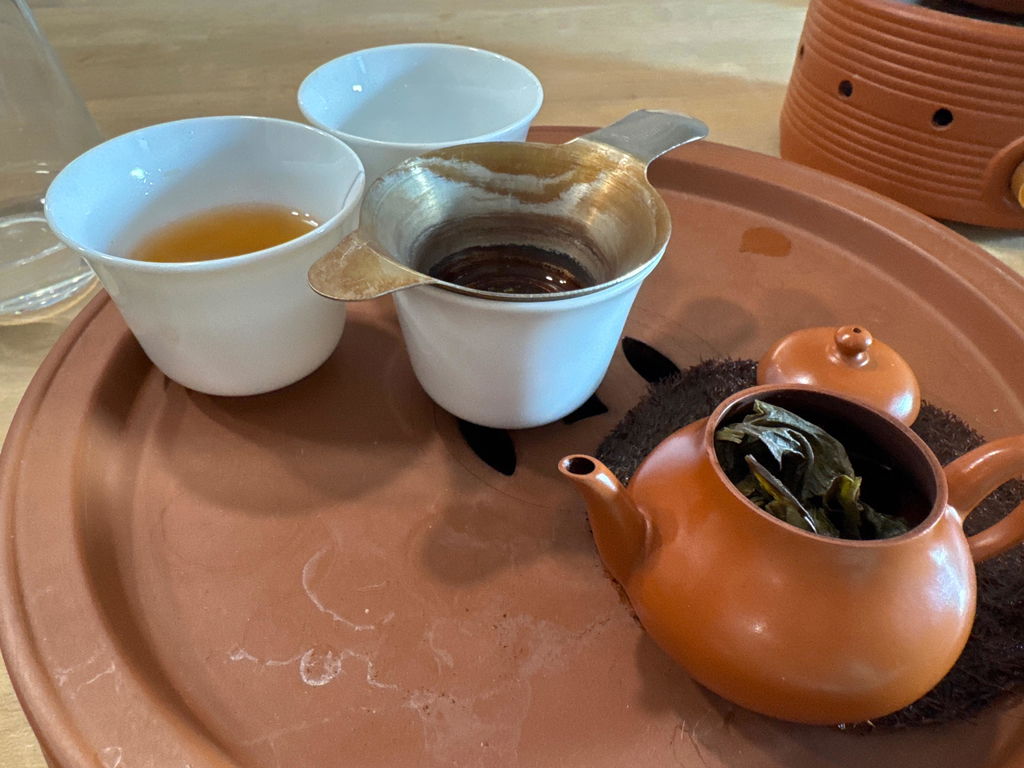
Tea: Buddha’s Hand (佛手)
Type: Charcoal Roasted Wuyi Rock Oolong
Harvest: Spring 2025
Roast Type: Medium - Heavy
Producer: Liu Qing 刘清
Region: Wuyi Mountain, Fujian, China
Tasting Notes: Mesquite, Butter, Berry Skin, Cream, Cinnamon
Buddha’s Hand, or Foshou 佛手, is a large-of-leaf Wuyi Yancha cultivar first grown in neighboring Yongchun. The leaves can grow larger than many farmer’s open hand. This cultivar has been a classic Yancha cultivar for a very long time, however many older groves were turn up to make room for the more popular Rougui in the past few decades, leaving the actual modern production of Foshou rather limited in its scale.
Liu Qing roasts this tea a little more heavily, but has let it sit for a year in a steel drum to allow the heat and fire of the roasting to settle slowly into the leaves. This represents the other side of Yancha when compared to his Pure Orchid cultivar which is much more floral and sweet. The Foshou is famed for its fruitiness and the iconic Wuyi Suan, 武夷酸, or Wuyi Sourness. This is a classic Yancha for those that appreciate the heavy complexity of true core region teas.
When the dry leaves are placed in a warmed gaiwan, we get the sour notes of berry skin, mesquite wood, and a hint of cinnamon all with a buttery background. In comparison with the Pure Orchid, there is much more fruit fragrances and much fewer florals in this tea.
The brew is a rich golden amber with plenty of mineral sweetness on the tongue. The mouthfeel is robust without being overpowering the fragrant wood notes lend the brew a pleasant Muzhi Xiang 木质香 or wood fragrance. As the session continues the sweetness of the leaves come gently to the forefront carried on notes of cream.
There are three peculiarities in the way we tend to brew Yancha:
First, we observe the Huanhun Tang 还魂汤 the return to life brew. This is when we pour the first infusion into a separate gongdaobei and drink it cool at the end of the session. This helps us remember what the tea was in the power of its youth.
Second, we enjoy brewing for longer intervals than we would in our other gongfu sessions. This menpao 闷泡 or long brew, gives more body to the infusions and shows the true nature of the tea, but it can also create a powerful session that usually has us sweating, best not done on an empty stomach.
Finally, and our yancha makers may cuff us for saying this, but we like to brew yancha at a lower-than-usual temperature, even using water as cool as 80 degrees celsius. This creates the opposite kind of session to the menpao, but brews the tea sweet and creamy and is highly enjoyable.